Why Skin Loses Lipids With Age (and What Your Moisturiser Can Actually Do)
By Glow Ritual
If your skin feels drier, less supple or suddenly harder to keep comfortable as you get older, lipids are part of the story. Skin is not simply a sheet that needs more water. Its outer barrier also depends on a carefully organised mixture of lipids, including ceramides, cholesterol and fatty acids. With age, both skin-surface oils and the lipid composition of the outermost layer can change.
That does not mean you need to “replace” your skin with one magic fat. It means a good moisturiser should help with the job moisturisers are actually good at: softening dry skin, reducing moisture loss and supporting a comfortable barrier while your skin goes through its very normal changes.

First, what are skin lipids?
Think of the outer layer of skin as a beautifully engineered wall. Skin cells form part of the structure, while lipids between them help organise the barrier that limits water loss and keeps the outside world outside.
Those barrier lipids are not the same thing as sebum, the oily mixture produced by sebaceous glands at the skin surface. Both matter, but they play different roles. This distinction is important because “your skin loses oil with age” is only part of a much more interesting picture.
What actually happens to lipids as skin ages?
Skin changes with age are not uniform. Surface oil production, the composition of barrier lipids and environmental exposure can all influence how dry skin feels. The menopause study linked below found changes in ceramide levels and average chain length; it does not show that a tallow moisturiser reverses those changes.
That matters because the organisation and composition of lipids can influence how well the outer barrier performs. Recent research in adults with dry, eczema-prone skin also found age-related changes in the stratum-corneum lipid profile alongside greater dryness and lower hydration. That study was in an at-risk population, so it should not be treated as a universal rule for every face, but it adds to the evidence that ageing skin is a lipid story as well as a collagen story.
Why menopause deserves its own chapter
For women, menopause can add another layer of change. Research examining stratum-corneum ceramides found that menopause was associated with changes in ceramide abundance and average chain length. Shorter ceramide chains have been associated in other research with less effective barrier organisation.
This helps explain why “my skincare suddenly stopped being enough” is such a familiar experience around midlife. It is not proof that one particular ingredient will reverse the change, and it certainly does not mean dry skin is inevitable. It does suggest that paying attention to moisturising and barrier comfort becomes increasingly sensible.
If this sounds familiar, read the Glow Ritual philosophy on feeding skin the lipids it loses with age.
So, should mature skin use fats and oils?
Often, yes, as part of a well-formulated moisturiser. Emollient oils, butters and fats can fill tiny gaps at the skin surface, improve softness and make rough, dry skin feel more flexible. More occlusive ingredients can also help slow water loss.
But “fat” is a category, not a guarantee. Tallow, shea butter, squalane and plant oils all have different compositions and textures. The finished formula, the amount you apply, your climate and your own skin matter more than internet claims that one fat is “identical” to human skin.
That is why we prefer to talk about lipid-rich skincare rather than pretending tallow is a biological copy-and-paste of your skin. For a broader comparison, see Tallow vs Plant Oils for the Face.
Where does tallow fit?
Tallow is a rich animal-derived fat containing a mixture of fatty acids. In skincare, its most defensible role is also its simplest: it works as an emollient, helping skin feel softer and more comfortable, and can contribute to the occlusive character of a moisturising formula.
That is useful. It does not need a mythology attached to it.
Glow Ritual takes traditional tallow skincare a step further by pairing a lipid-rich base with 4% niacinamide and squalane. We call that Advanced Tallow Skincare: an old-school moisturising ingredient used inside a modern formula rather than treated as the whole routine.
Why add niacinamide?
Niacinamide is a form of vitamin B3 with a much larger body of topical skincare research behind it than tallow. It has evidence for supporting aspects of barrier function and is also widely used to improve the appearance of uneven tone.
The point is not to turn one moisturiser into a chemistry set. It is to make each ingredient earn its place. If you want the ingredient-level version, read Niacinamide + Tallow: What Each Ingredient Does.
And why squalane?
Squalane is a silky emollient. In a richer formula, it can contribute slip and softness without relying entirely on heavier fats and butters. That is useful if you like the cushioned feel of lipid-rich skincare but do not want your face to feel coated.
Our guide to squalane for dry, mature skin explains its role in more detail.
What a lipid-rich moisturiser can and cannot do
A moisturiser can help dry skin feel softer, reduce moisture loss and support comfort. When it contains well-chosen actives, it may also offer additional cosmetic benefits.
It cannot replace sunscreen. It cannot restore declining oestrogen. It cannot rebuild lost facial volume or erase wrinkles. And no cosmetic moisturiser should be sold as a treatment for eczema, dermatitis or another medical skin condition.
That boundary is not boring. It is useful. Once you stop asking a moisturiser to perform dermatological wizardry, it becomes much easier to choose one for what your skin actually needs.
A simple lipid-friendly routine
For dry or changing skin, start with the basics: cleanse gently when needed, moisturise before freshly cleansed skin has had time to become tight, and use broad-spectrum sunscreen in the morning. Add stronger actives only if they suit your skin and you genuinely want them.
You can also try applying moisturiser while skin is still slightly damp. Humectants such as panthenol and glycerin help skin hold on to that water, while rich lipids help keep it there.
More layers are not automatically more sophisticated. Sometimes the grown-up skincare move is knowing what you can leave out.
The bigger idea: skin longevity is not about fighting age
Healthy ageing does not require treating every line as a defect. Skin longevity is a more useful lens: protect skin from UV, keep the barrier comfortable, choose products you can use consistently and avoid creating irritation in pursuit of perfection.
As skin changes, giving it a little more lipid-rich support can be a very sensible part of that approach. Not because fats turn back the clock, but because comfortable, well-moisturised skin tends to look and feel better at every age.
Glow Ritual Advanced Tallow Skincare
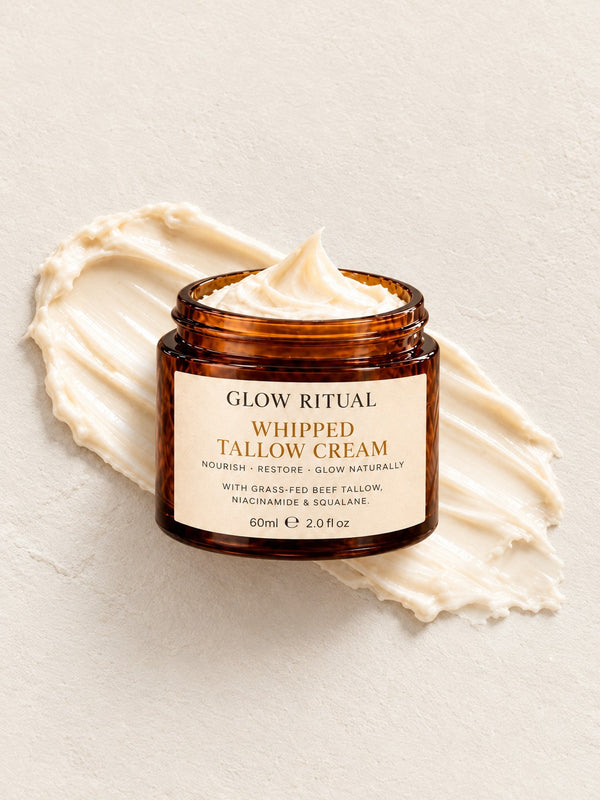
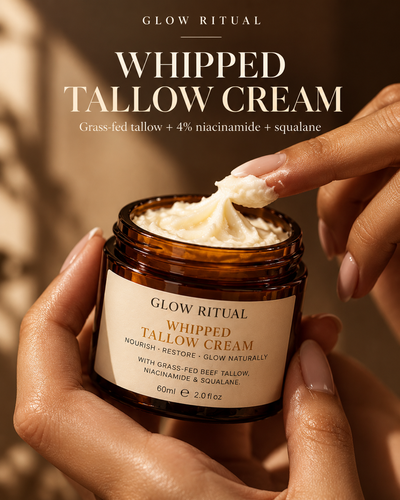
Our Whipped Tallow Cream combines a lipid-rich tallow base with 4% niacinamide and squalane for one simple moisturising step.
Research and further reading
- Kendall and colleagues (2022): menopause and changes in skin ceramides. This study examined skin lipids; it did not test tallow or Glow Ritual.
- Tanno and colleagues (2000): nicotinamide and epidermal barrier function. Ingredient research does not establish identical results for every finished formula.
- American Academy of Dermatology: practical skin care during menopause.
Explore every ingredient in our Face Cream, Cleansing Balm and Body Cream in the Glow Ritual ingredients guide, or read our skin-food philosophy.