Can Tallow Skincare Cause Breakouts or Reactions? What to Know
By Glow Ritual
Share
Yes, it is possible for some people to experience breakouts, congestion or irritation when introducing tallow skincare. Tallow is a rich, lipid-heavy ingredient, and skin is wonderfully individual. A formula that feels deeply nourishing on dry or mature skin may simply feel too rich for someone who is very oily or prone to clogged pores.
That does not automatically mean tallow is “bad” for skin, nor does every spot that appears after trying a new product prove the product caused it. It means skincare needs to be judged by how your skin responds.
Why can a rich moisturiser cause breakouts for some people?
Moisturisers work partly by softening the outer layer of skin and reducing water loss. Richer creams and ointments are often useful for dry skin precisely because they create a stronger moisturising layer. But dermatologists also recognise that some people, particularly those with oily or acne-prone skin, can find heavier moisturisers too occlusive or pore-clogging.
Tallow is a rendered animal fat made largely from lipids. That richness is part of its appeal for dry-feeling skin, but it is also why it may not suit every face.
Importantly, there is still limited direct clinical research on topical tallow in humans. A 2024 scoping review found significant gaps in the evidence, particularly around side effects, and concluded that more controlled research is needed. So claims that tallow never clogs pores, or that it is universally suitable for acne-prone skin, go further than the evidence currently allows.
A breakout is not necessarily an allergy
It helps to separate a few different reactions that can look similar in the mirror.
Congestion or breakouts may look like small bumps, whiteheads, blackheads or pimples. A very rich product may contribute to this in some acne-prone people.
Irritation is more likely to involve burning, stinging, redness or uncomfortable dryness.
Allergic contact dermatitis can cause redness, itching and swelling. And the trigger does not necessarily have to be the headline ingredient. Any skincare formula contains multiple ingredients, and an individual can potentially react to one of them.
That is why it is difficult to look at a photograph of a skin flare and confidently declare that one ingredient caused it. Timing can provide a clue, but acne, hormonal changes, other skincare, hair products, medications, stress and many other factors can overlap.
Does skin need to “purge” when starting tallow?
We would be cautious with this explanation. Tallow is not an exfoliating acid or retinoid, so we do not think customers should be encouraged to push through a worsening breakout on the assumption that their skin is simply “purging”.
If a new moisturiser repeatedly seems to make your skin worse, stop using it and allow your skin to settle. Skincare should feel supportive, not like an endurance event.
How much tallow moisturiser should you use?
Often, less than you think.
Because tallow is lipid rich, applying a thick layer to the entire face can be unnecessary. Start with a small amount, warm it between clean fingertips and press it gently into the areas that need moisture most.
Applying moisturiser to slightly damp skin can also help a small amount spread comfortably. We explain the technique in Should You Apply Moisturiser to Damp Skin?.
If your cheeks are dry but your forehead and nose become oily, you do not necessarily need to moisturise every part of your face identically. Combination skin can benefit from treating different areas differently.
Who should be more cautious with rich tallow skincare?
If you know that your skin is very oily, highly acne-prone or easily congested by rich creams, introduce tallow slowly rather than immediately applying it generously morning and night.
The American Academy of Dermatology recommends people with acne-prone skin look for products described as non-comedogenic or unlikely to clog pores. There is no universal ingredient list that guarantees a product will suit every acne-prone person, so your own response still matters.
If you are deciding whether a richer formula suits you, you may also find our guides Does Tallow Balm Clog Pores? and Does Tallow Balm Clog Pores? What You Need to Know useful.
Patch testing is a sensible first step
Even beautifully formulated skincare can disagree with an individual complexion. Dermatologists recommend testing a new skincare product on a small area before introducing it more widely, particularly if your skin is reactive.
The American Academy of Dermatology suggests applying a product to a small test area twice daily for seven to ten days, using approximately the same amount and contact time you would normally use. If redness, itching or swelling develops, stop using it.
A patch test cannot guarantee that a product will never contribute to facial breakouts, but it can be useful for spotting irritation or contact reactions before full-face use.
What should you do if your skin reacts?
Stop using the new product and keep the rest of your routine simple while your skin settles. Avoid immediately throwing extra exfoliants or active ingredients at the problem, because that can make irritated skin harder to interpret.
If you experience significant swelling, blistering, persistent pain, spreading rash, breathing difficulty or another severe reaction, seek appropriate medical care. Persistent or recurrent reactions are also worth discussing with a GP or dermatologist.
Why formulation matters
There is an important difference between rubbing home-rendered animal fat directly onto the face and using tallow as one component of a formulated cosmetic product.
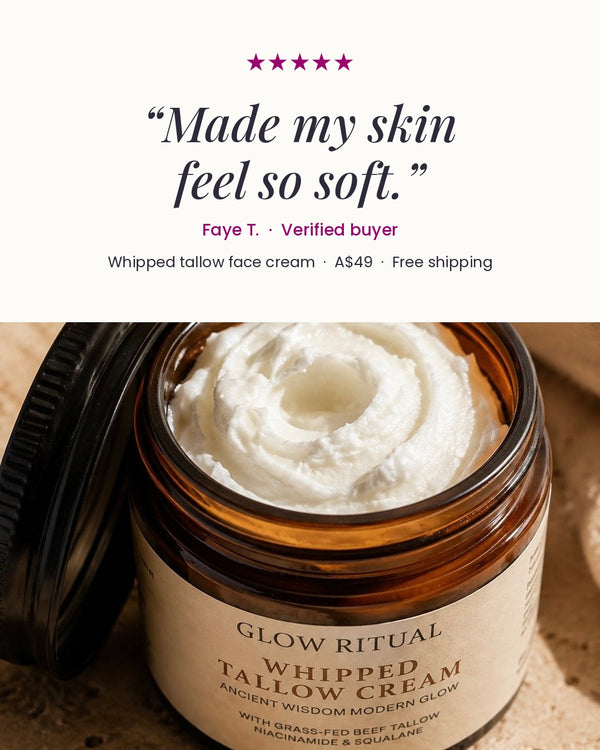
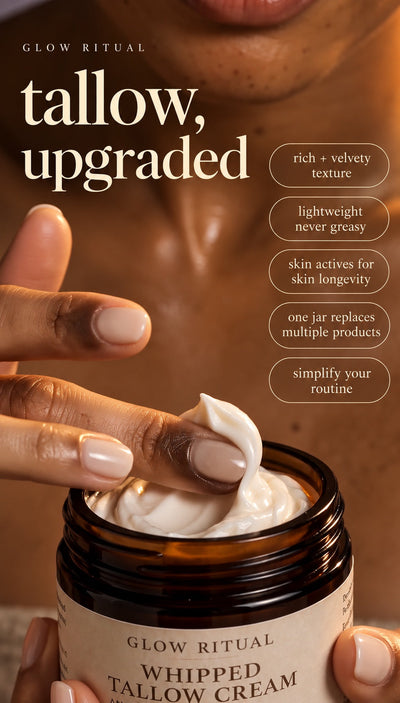
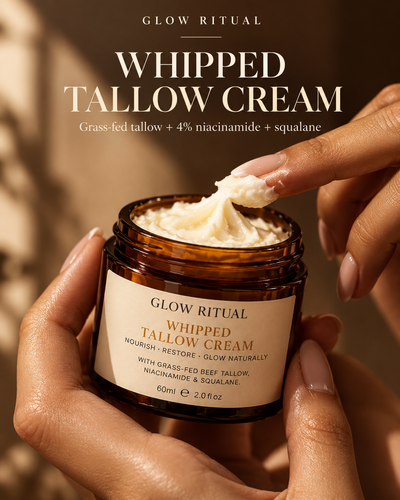
Glow Ritual’s approach is Advanced Tallow Skincare. Rather than treating tallow as a miracle ingredient, we pair its lipid-rich moisturising qualities with ingredients such as 4% niacinamide and squalane to create a more considered daily moisturiser.
You can explore the role of those ingredients in Niacinamide + Tallow: What Each Ingredient Does and Why Use Squalane in Skincare?.
The bottom line
Tallow can be a beautifully rich moisturising ingredient for dry, changing and mature-feeling skin, but richness is not automatically better for everyone. Some complexions may find a tallow-based product too heavy, and any skincare product can potentially cause irritation or an individual reaction.
We would rather be transparent about that than pretend there is one perfect ingredient for every face.
Start slowly. Use a small amount. Patch test if you are reactive. And listen to what your skin is telling you.
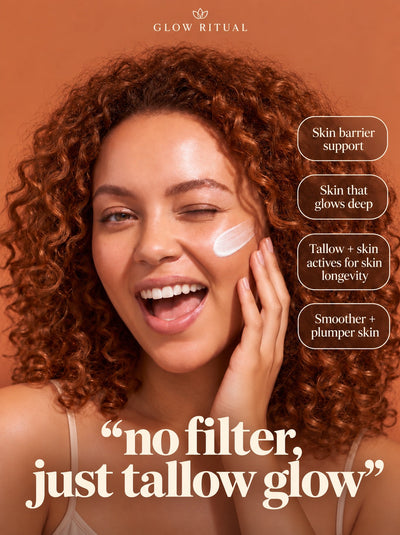
Prefer a simpler approach? Discover Glow Ritual Advanced Tallow Skincare, our tallow face moisturiser formulated with 4% niacinamide + squalane for a simple, one-jar moisturising ritual.