The Cost of Overcomplicated Skincare
By Glow Ritual
Share
Why simplifying your routine might be the best thing you do for your skin, your hormones, and your wallet.
Walk into any beauty retailer today and you'll find shelves overflowing with cleansers, essences, toners, acids, peptides, retinols, boosters, oils, masks and serums. Somewhere along the way, healthy skin became less about caring for it and more about building an ever-growing collection.
The beauty industry has convinced many of us that more products equal better skin.
But does it?
For many women, especially those navigating their 30s, 40s and beyond, the hidden costs of an overcomplicated skincare routine are becoming impossible to ignore.
Not just financially.
Physically.
Mentally.
And sometimes, even hormonally.
Let's explore the four costs no one talks about.
The Financial Cost
When did skincare become a mortgage?
Australia is experiencing one of the toughest cost-of-living periods in decades.
Groceries cost more.
Insurance costs more.
Mortgages cost more.
Yet skincare routines somehow keep getting longer.
Recent Australian consumer data suggests people spend around $454 per year on beauty products on average, while skincare essentials such as cleansers, serums and moisturisers remain among the most commonly purchased categories. Industry research also shows Australians are increasingly prioritising value for money when buying skincare. (ABC News)
The bigger question is this:
Why does one moisturiser suddenly need five supporting products?
The answer isn't necessarily because your skin needs them.
It's because product launches drive growth.
A serum today becomes a booster tomorrow.
Then a peptide mist.
Then a recovery essence.
Then a "skin cycling" product designed to work with the first three.
Each new product creates another reason to purchase.
Another step.
Another subscription.
Another refill.
Beauty companies are incredibly good at introducing tiny problems that conveniently require another bottle to solve.
This isn't a conspiracy.
It's simply how mature consumer markets grow.
Luxury skincare has also borrowed heavily from luxury fashion.
Limited editions.
Designer packaging.
Celebrity endorsements.
Collectability.
Owning products has quietly become part of personal identity.
But your skin barrier has no idea whether your moisturiser cost $25 or $250.
It only responds to how consistently and gently it's cared for.
The Hormonal Cost
Your skin changes because you do.
One of the biggest reasons women suddenly feel like their skincare has "stopped working" is that their skin itself is changing.
During perimenopause and menopause, declining oestrogen affects much more than reproductive health.
It can influence:
* skin hydration
* collagen production
* oil production
* wound healing
* barrier function
* overall skin sensitivity
Many women notice that products they tolerated for years suddenly sting, burn or leave their skin feeling tight.
Not because they're doing something wrong.
Because their skin is asking for something different.
As our barrier naturally becomes more fragile with age, protecting it often becomes more valuable than constantly challenging it with stronger active ingredients.
Inflammation also plays an important role in visible skin ageing.
A healthy skin barrier helps reduce unnecessary irritation and supports the skin's natural repair processes.
You'll also hear increasing discussion about endocrine-disrupting chemicals in cosmetics. While research is ongoing and evidence varies between ingredients and levels of exposure, many consumers choose to simplify their routines and reduce unnecessary ingredient overload as a precaution rather than from fear. There isn't strong evidence that everyday skincare products, when used as directed, broadly disrupt hormones, but choosing fewer well-formulated products can still make sense for women whose skin has become more reactive.
The goal isn't to declare everything toxic.
It's to recognise that changing hormones often call for a gentler approach.
Sometimes less really is more.
The Mental Cost
The routine that became another job.
Remember when skincare meant washing your face and putting on moisturiser?
Now we're told we should:
* double cleanse
* tone
* exfoliate
* alternate acids
* rotate retinoids
* layer peptides
* use vitamin C
* apply hyaluronic acid to damp skin
* seal everything with an overnight mask
Miss one step and social media tells you your skin will suffer.
It's exhausting.
Many women don't just buy products anymore.
They buy pressure.
Pressure to optimise.
Pressure to keep up.
Pressure to age perfectly.
Ironically, something intended to become self-care has started feeling like another task on an already overflowing to-do list.
Healthy skin shouldn't require a spreadsheet.
The Skin Barrier Cost
Your skin isn't broken.
It might just be overwhelmed.
Every active ingredient asks your skin to do something.
When carefully chosen, those ingredients can be incredibly helpful.
But layering too many products can sometimes leave skin irritated, dehydrated and confused.
A healthy skin barrier acts like your body's natural shield.
It helps lock moisture in while keeping irritants out.
When that barrier becomes compromised, skin often feels:
* tight
* dry
* reactive
* flaky
* uncomfortable
The answer isn't always another serum.
Sometimes it's simply giving your skin the nourishment and consistency it's been asking for.
A Simpler Way Forward
At Glow Ritual, we believe skincare should support your life, not take it over.
Our philosophy is simple:
Choose ingredients that nourish.
Protect your skin barrier.
Work with your skin instead of constantly trying to "fix" it.
Because healthy skin isn't created by owning more products.
It's built through consistency, simplicity and understanding what your skin truly needs.
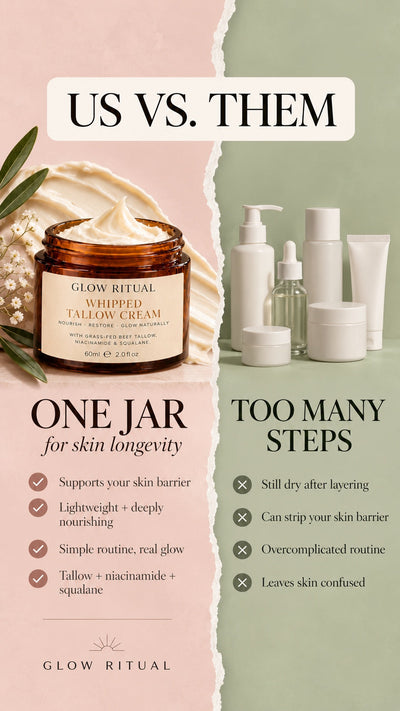
What if one jar really was enough?
Maybe the future of skincare isn't another step.
Maybe it's having fewer.
More intention.
Less noise.
Because your skin deserves peace just as much as you do.